
Agentic AI and Documents: What Happens When Files Start Acting on Their Own
Table of Contents
Most people who work with documents at scale will tell you the same thing: the problem was never finding the right software. It was getting people to actually use it consistently, in the same way, every time.
A shared drive fills up. Naming conventions drift. Someone saves a contract in the wrong folder, or doesn't save it at all. An invoice sits in an inbox for four days because the right person was out. A compliance document expires quietly because nobody had it on their calendar.
None of these are catastrophic failures. They're just the ordinary friction of document-heavy work and they add up fast. A few minutes here, a missed deadline there, an audit that takes three weeks of prep instead of three hours.
Agentic AI is the first technology that actually addresses the root cause rather than adding another layer on top of it. Not a better folder structure. Not a smarter search. Documents that process themselves - routing, flagging, validating, and triggering actions without waiting for someone to tell them what to do.
What Is Agentic AI, and Why Does It Change Everything for Documents?
Most AI that businesses use today is reactive. You ask, it answers. You upload a file, it extracts. There's a human in the loop for every decision, every step.
Agentic AI is different. It's autonomous, goal-driven AI that doesn't just respond to prompts. It reasons, plans, and acts independently to complete complex tasks. Think of the difference between a calculator and a financial analyst: one processes input, the other thinks ahead.
Applied to document processing, this changes the fundamental nature of a file. Instead of a passive object waiting in a folder, a document becomes an active participant in a workflow, one that can perceive its context, reason about what needs to happen next, and take action without being told.
This is why document management can't stay static. As we've explored in our piece on document management trends for 2026, the shift from file storage to intelligent workflows is already underway.
From OCR to Agentic OCR: A Technology That Finally Grew Up
To understand where agentic document processing sits, it helps to trace the path that got us here.
Early Optical Character Recognition (OCR) was essentially pixel mapping - it turned scanned images into machine-readable text, but understood nothing about what it was reading. An invoice and a legal brief looked the same to it: strings of characters.
Then came Intelligent Document Processing (IDP) - systems that could extract structured data from semi-structured documents. Better, but still template-dependent. Change the invoice format, break the extraction.
Document AI represented the next leap: LLM-powered systems that could read, reason, and to some extent execute. But they still required human orchestration at key decision points.
How AI Agents Actually Process Documents
Understanding the mechanics matters, because the capability follows directly from the architecture.
An AI agent processing a document moves through a cycle:
- Perceive - intake the document, understand its format, type, and content
- Reason - assess what the document means in context: is this an expired contract? A flagged invoice? A new client intake form?
- Plan - determine the sequence of actions required based on the document's content and the rules of the workflow
- Act - execute: route, tag, escalate, archive, trigger a downstream task
- Reflect - evaluate the outcome and adjust if something didn't go as expected
This loop runs continuously, across thousands of documents, without fatigue and without the kind of inconsistency that creeps into manual processes over time.
It's also why the concept of AI-driven Enterprise Content Management has shifted from a nice-to-have to a structural necessity for organizations that handle high document volumes.
Agentic Workflows: Documents That Route, Validate, and Act
Here's where the abstract becomes concrete.
Take an invoice arriving in a financial institution's accounts payable system. In a traditional setup: someone opens it, checks it against the purchase order, routes it for approval, logs it, and files it. Each step is a potential delay, a potential error.
In an agentic workflow:
- The invoice is ingested automatically across any format
- The agent cross-references it against existing purchase orders and vendor records
- Discrepancies trigger an escalation - routed to the right person with context already attached
- If everything matches, approval workflows initiate without human input
- The document is classified, tagged, and archived with a complete audit trail
The same logic applies to contracts flagging renewal windows, compliance documents triggering review cycles, and client onboarding forms routing to the right team based on the services requested.
This is particularly valuable in sectors like financial services, where document volume is high, error tolerance is low, and audit requirements are non-negotiable. As we've written about in the context of compliance automation in financial services, the real cost of document chaos isn't just inefficiency, it's risk.
The Architecture Behind Agentic Document Systems
What makes this possible at scale is a specific technical architecture, and it's worth understanding the building blocks.
Multi-agent systems are architectures where multiple specialized AI agents collaborate, coordinated by an orchestrator agent. Think of it like a law firm: a paralegal agent reads and classifies incoming documents; a contract agent checks clause compliance; an escalation agent determines when a human needs to intervene; and an orchestrator coordinates the whole chain.
The reasoning engine underneath all of this is a Large Language Model - the component that gives agents their ability to understand context, generate plans, and make judgment calls rather than just pattern-match against templates.
The result is a system that doesn't just process documents faster. It processes them smarter - adapting to new document types, edge cases, and evolving business rules without requiring a developer to rewrite a template every time something changes.
When Documents Trigger Decisions
The most significant shift agentic AI brings isn't speed. It's causality.
In traditional document management, documents are outputs (they record what happened). In agentic systems, documents are inputs, they drive what happens next.
A compliance document that's about to expire doesn't sit quietly in a folder. It triggers a notification, opens a review task, and escalates if no action is taken within a defined window.
An anomalous invoice doesn't route to the standard approval flow, it flags for fraud review. A contract approaching its renewal date doesn't require a calendar reminder - it surfaces automatically with the relevant history attached.
This is what we mean when we talk about documents that work for you rather than waiting to be found.
Cross-document reasoning takes this further. An agent that can read an invoice, reference the associated contract, check the vendor's compliance records, and cross-check against current regulatory requirements is doing something qualitatively different from extraction. It's doing analysis - at scale, automatically, every time.
Human-in-the-Loop As The Necessary Counterbalance
None of this means removing humans from document workflows entirely — and any serious implementation of agentic AI in document processing shouldn't try to.
Human-in-the-loop is the practice of incorporating human review at critical decision points within automated workflows. In an agentic document system, this means defining precisely which decisions the AI handles autonomously, and which ones require a human sign-off before proceeding.
For routine processing full automation is appropriate and efficient. For high-stakes decisions, human judgment stays in the loop.
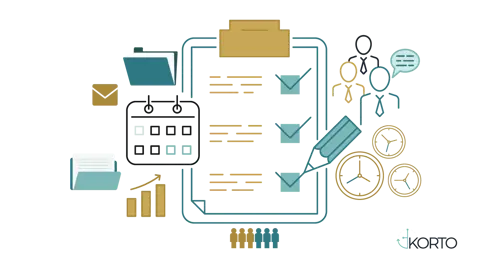
Regulated industries don't get to guess. They need to know exactly who touched a document, when, and why. In an agentic system, that record exists automatically. Every action is logged, every escalation is traceable, and human sign-off is required where the stakes are high enough to warrant it.
That's not a limitation of the technology. It's what separates intelligent content management from just running faster on autopilot.
The Direction of Travel
Documents have always carried organizational knowledge. What's changing is whether that knowledge stays locked inside a file, or whether it flows through a system that can act on it.
Agentic AI makes the latter possible. Not by replacing the humans who work with documents, but by handling the volume, the routing, the classification, and the decision-triggering that currently absorbs hours every week, empowering knowledge workers rather than replacing them.
The organizations getting ahead of this aren't treating it as a technology upgrade. They're treating it as a fundamental rethink of what a document is, and what it should be capable of.
That's the right framing. And the right time to start.
Stop Managing Documents. Let KORTO Do It For You.
If any of this sounds familiar you already know the problem. KORTO is built to fix it.
We use AI to automatically classify, tag, route, and manage the lifecycle of your documents, with compliance and security built in from the start. Not another folder system. Not another manual process with a digital coat of paint. Actual automation that works the way your business does.
Ready to see it in practice? Talk to the KORTO team today.
5-Second Summary
Traditional document management relies on people to move, review, and organize files. Agentic AI changes that by enabling documents to understand their context, trigger workflows, and take action autonomously. The result is faster processing, fewer errors, stronger compliance, and document systems that actively support your business instead of slowing it down.