
What is the Life Cycle of Records?

Table of Contents
Every business record has a life cycle. It is created or received, used to support work, retained for as long as it has business or legal value, and eventually destroyed or preserved. A records life cycle gives your organization a repeatable way to control that journey instead of leaving files in folders, inboxes, and storage systems without clear ownership.
The model is useful for paper records, electronic documents, email, messages, images, contracts, invoices, and other information created or received during business activity. The exact number and names of stages vary by records-management program, but the core decisions remain the same: create and capture the right record, keep it usable and secure, retain it for the required period, and apply an authorized final disposition.
What is the records life cycle?
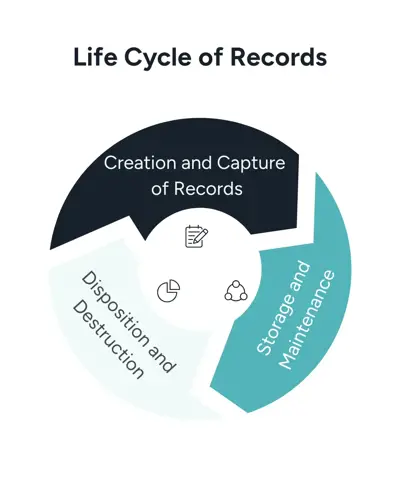
The records life cycle is the series of stages a record passes through from creation or receipt to final disposition. A practical model includes creation and capture, active use, inactive storage and retention, and disposition through secure destruction or archival preservation. Records management assigns rules, ownership, access, and retention controls to each stage.
Records life cycle vs. records lifecycle
“Records life cycle” and “records lifecycle” describe the same records-management concept. Both refer to the changing status of a record from creation or receipt through use, storage, retention, and final disposition. Search results and professional sources use both spellings, so this guide uses records life cycle in headings and includes records lifecycle naturally in the text.
Why the records management lifecycle matters
A lifecycle approach does more than specify where a document is stored. It defines what the record is, why the organization needs it, who may access or change it, how long it must be retained, and what should happen when that period ends.
A controlled records management lifecycle helps organizations:
- find authoritative records when they are needed;
- preserve context through classification and metadata;
- limit access to people with a legitimate business need;
- separate active records from information that is no longer used daily;
- apply retention rules consistently;
- suspend ordinary disposition when a legal hold or other approved exception applies; and
- document destruction or archival transfer so the final action is authorized and traceable.
The result is better operational continuity and a more defensible information-governance process. It also reduces the risk of both premature destruction and indefinite retention.
The four stages of the records life cycle
Different authorities describe the lifecycle using three, four, five, or six stages. For example, some models combine active use and storage, while others separate classification, retention, preservation, and disposition. The four-stage model below is simple enough for an overview and detailed enough for an enterprise records-management program.
1. Creation and capture
The records life cycle begins when an organization creates or receives information in the course of business. Examples include a signed contract, an invoice, an employment record, an email that documents a decision, a customer submission, or a report generated by a business system.
At this stage, the organization should decide whether the information is an official record or a non-record copy. It should also capture the context needed to manage it later. Depending on the record type and system, useful context may include the creator, business function, date, record category, relationship to a transaction, version, and access restrictions.
Good capture practices include:
- creating or receiving the record in an approved system;
- identifying the record category and its business owner;
- applying a consistent classification or taxonomy;
- capturing required metadata; and
- avoiding unnecessary duplicate copies.
Classification is important because it connects a record to its retention rule, access permissions, storage location, and eventual disposition. A record that is not classified reliably is difficult to retrieve and difficult to manage consistently.
2. Active use and maintenance
An active record is regularly needed for current work. It may support a project, customer relationship, transaction, investigation, approval, or operational process. Active records must be available to authorized users and protected against inappropriate changes, loss, or duplication.
During active use, records-management controls may include:
- role-based access and permission reviews;
- version control or a designated record copy;
- approval and signature history;
- audit trails for access or changes;
- controlled sharing and download; and
- a documented process for closing or cutting off the record.
A record may be edited while it is still a working document. Once it is finalized or reaches the point defined by the retention policy, it may need to become read-only or otherwise protected from routine alteration. In records-management systems, this transition is often called cutoff. Cutoff marks the point at which the retention period begins; the exact trigger depends on the record category and the organization’s approved schedule.
3. Inactive storage and retention
When a record is no longer needed for day-to-day work but still has business, legal, fiscal, regulatory, or historical value, it enters inactive storage or retention. It should remain discoverable, secure, and accessible to authorized users without occupying the same working environment as active information.
A retention schedule should identify, for each record category:
- the retention trigger;
- the length or rule for the retention period;
- the responsible owner;
- any transfer or review point; and
- the approved final disposition.
Retention periods are not universal. They depend on the record type, the organization’s obligations, the relevant jurisdictions, business needs, and any approved policy. The editorial owner should verify all retention examples against Korto’s target market and legal review before publication.
Retention is also not the same as backup. A backup is generally intended for recovery after a system or operational failure. A retained record is managed as evidence of business activity and must remain identifiable, usable, and governed according to its record category.
A retention process should also account for exceptions. A legal hold, investigation, audit, access request, or other approved preservation requirement may suspend ordinary destruction. When an exception applies, the hold must be documented, communicated to the responsible teams, and released through an authorized process.
4. Disposition and preservation
Disposition is the authorized end of the record’s managed life cycle. A record may be securely destroyed, transferred to an archive, or retained indefinitely when policy or historical value requires it. The outcome should be based on the approved retention rule and any active exceptions—not on convenience or an individual employee’s preference.
A defensible disposition process should include:
- a review of the records scheduled for action;
- confirmation that no legal hold or other exception applies;
- approval by the designated owner or authority;
- secure destruction or controlled archival transfer; and
- documentation of what was destroyed or transferred, when, under which rule, and by whom.
Destruction must make the information unreadable or inaccessible in the relevant medium. For digital records, the process should address managed copies and applicable backups according to the organization’s policy and technical environment. For permanent records, preservation may require controlled storage, description, format planning, and continued access arrangements.
Records life cycle stages at a glance
| Stage | Main question | Typical controls | Exit decision |
|---|---|---|---|
| Creation and capture | Is this information an official record, and what context must be captured? | Classification, metadata, ownership, approved capture | Record is classified and available in the right system |
| Active use and maintenance | Who needs the record, and how should it be protected while work continues? | Access permissions, version control, approvals, audit trail | Record is closed or reaches the defined cutoff point |
| Inactive storage and retention | How long must the record remain available, and under which rule? | Retention schedule, secure storage, retrieval controls, legal holds | Retention ends or an approved transfer/review point occurs |
| Disposition and preservation | Should the record be destroyed, archived, or retained? | Authorization, secure destruction, archival transfer, disposition log | Destruction or preservation is completed and documented |
How the lifecycle applies to digital and physical records
The lifecycle applies regardless of format, but the controls are not identical.
For physical records, organizations must control filing, location, movement, environmental conditions, access, scanning decisions, and secure destruction. A box or file should have enough identifying information to support retrieval without exposing sensitive content unnecessarily.
For digital records, organizations must control classification, metadata, permissions, versions, audit history, storage locations, migrations, exports, and disposition. Digital information can be copied quickly, so the program should define which copy is authoritative and how duplicates, exports, and system-generated copies are handled.
Hybrid environments require one policy across both formats. Otherwise, a paper file and its scanned version may receive different retention treatment, or an email may be excluded even though it documents the same business decision as a formal document.
Who manages each stage?
Records management is an organization-wide responsibility, even when a records manager or information-governance team owns the program.
A practical responsibility model may look like this:
- Record creators and business users capture information accurately and follow classification, access, and handling rules.
- Business owners define why the record exists, who needs it, and when the business activity ends.
- Records or information-governance teams maintain the taxonomy, retention schedule, procedures, training, and monitoring process.
- IT and system owners maintain the systems, permissions, integrations, migrations, and technical disposition controls.
- Legal, compliance, or risk teams advise on legal holds, investigations, regulatory requirements, and policy exceptions.
- Archivists or designated custodians manage records selected for long-term preservation.
The exact roles should be documented in Korto’s records-management policy. The organization should not publish a named standard, certification, or legal obligation here unless the claim has been verified for the intended market.
Best practices for managing the records lifecycle
Start classification at capture
Do not wait until a storage cleanup project to decide what records are. Define the record categories, business owners, and minimum metadata before information enters the managed repository.
Separate active work from retention storage
Active users need fast access and controlled collaboration. Inactive records need reliable retention, retrieval, and protection. Separating the two states reduces clutter and makes it easier to apply the right controls.
Treat retention as a policy, not a guess
Create a retention schedule with documented triggers and owners. Review it when business processes, jurisdictions, systems, or legal requirements change. Do not insert a generic number of years into this article unless Korto has approved a specific, sourced example.
Document exceptions before disposition
A legal hold or investigation can override an ordinary retention rule. Make the hold visible to the people and systems responsible for disposition, and document the release before normal processing resumes.
Make access and changes traceable
Use permissions, version history, approvals, and audit records appropriate to the sensitivity and purpose of the record. Review access when roles change and remove temporary access when it is no longer needed.
Test retrieval and disposition
A policy is only useful if the organization can find records and carry out the final action. Test representative searches, retention workflows, exports, archival transfers, and destruction records on a planned basis.
Train the people who create records
Training should explain what counts as a record, where it must be captured, how it is classified, who may access it, and what happens at the end of retention. Short, role-specific guidance is more useful than a policy that employees cannot apply during daily work.
How ECM software supports the records life cycle
An enterprise content management system can connect capture, classification, access, workflow, retention, and audit evidence in one operating model. The specific features depend on the product configuration and should be verified before publication.
In Korto, link this section to compliance-ready ECM after explaining that lifecycle controls can support audit readiness, permissions, and workflow consistency. Link to security and audit trails when discussing access control and traceability. Link to data retention procedures when discussing retention and disposition workflows.
A useful implementation sequence is:
- identify the record categories and business owners;
- map the lifecycle states and cutoff triggers;
- define permissions and required metadata;
- configure retention and exception workflows;
- test retrieval, audit evidence, and disposition; and
- train users and review the program regularly.
Final takeaway
The records life cycle is a practical framework for keeping information usable, secure, and accountable from creation through final disposition. Start by classifying records at capture, control active use, apply a verified retention schedule, protect exceptions, and document destruction or preservation.
With those controls in place, records management becomes a repeatable business process rather than a last-minute search through scattered files.
5-Second Summary
The records life cycle consists of three essential stages: creation, storage, and disposition, each requiring strategic management to ensure compliance and efficiency. Properly handling records prevents legal risks, enhances accessibility, and optimizes storage costs. Implementing best practices like clear policies, employee training, and secure storage safeguards records throughout their lifespan.
FAQ
What are the stages of the records life cycle?
A practical four-stage model includes creation and capture, active use and maintenance, inactive storage and retention, and disposition through secure destruction or archival preservation. Some programs separate classification, retention, preservation, or cutoff into additional stages.
What is the difference between a records life cycle and a records management lifecycle?
The records life cycle describes how a record changes from creation to final disposition. The records management lifecycle adds the policies, people, metadata, permissions, retention schedules, workflows, and audit controls used to manage those changes.
What is the most important stage of the records lifecycle?
No single stage works in isolation. Early classification and capture are especially important because they determine how the record can be found, protected, retained, and disposed of later. A strong program also needs controlled disposition at the end.
What is the difference between active and inactive records?
Active records are needed frequently for current work. Inactive records are no longer used regularly but must remain available for a defined business, legal, fiscal, regulatory, or historical reason. The transition point should be defined by policy or a retention schedule.
Does retention mean keeping every record indefinitely?
No. Retention means keeping a record for the period and purpose defined by an approved rule. Keeping information longer than necessary can increase storage, security, discovery, and governance risk. A legal hold or other exception may temporarily suspend ordinary disposition.
What is final disposition?
Final disposition is the authorized end of a record’s managed life cycle. It normally means secure destruction, transfer to an archive, or an approved decision to maintain the record indefinitely. The action should be reviewed and documented.
How does the records life cycle apply to email and digital messages?
An email or message may be a record when it documents a business transaction, decision, obligation, or activity. The organization should define which messages are records, where they must be captured, how they are classified, and how retention and legal holds apply.